Two homes, the same country, wildly different starting points. In Battersea's SW11 7 postcode sector, effectively every single home holds an EPC of Band C or above. More than a hundred miles north, in Birmingham's B44 8, fewer than one in eight does.
That 88-point gap is the sharp end of England and Wales's energy-efficiency divide — and almost no one has measured it at this resolution. Official statistics — the ONS housing energy-efficiency analysis and the government's quarterly Energy Performance of Buildings release — stop at local-authority level. We went deeper: a first-party analysis of all 29,162,710 EPC certificates on the official MHCLG register, cut 31 May 2026, broken down across 2,368 postcode districts and 8,588 postcode sectors.
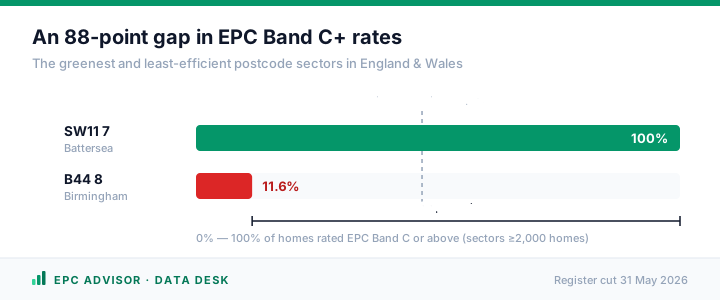
The greenest and least-efficient qualifying postcode sectors in England & Wales — a clear 88.4-point spread. Register cut 31 May 2026.
About this analysis. Figures are computed by the EPC Advisor Data Desk from the official MHCLG "Get Energy Performance Data" register (Open Government Licence), cut 31 May 2026. Area league tables count properties by their latest certificate; to keep rankings reliable we include only sectors with at least 2,000 homes and districts with at least 3,000. "Band C+" means a current rating of A, B or C. Full method and caveats are at the foot of this page.
Key findings
- The least-efficient qualifying sector, B44 8 (Birmingham), is just 11.6% Band C+; at the other extreme a cluster of sectors — including Battersea's SW11 7 — reach 100%, an 88.4-point spread (register cut 31 May 2026, sectors with ≥2,000 homes).
- Across 4,923 qualifying sectors, the median is 46.7% Band C+, with the middle half falling between 39% and 55%.
- At district level the spread runs 100% (E20, Stratford) to 18.2% (SP3, rural Wiltshire) — an 81.8-point range across 1,848 qualifying districts.
- Nationally, 52.3% of all 19.7 million certified homes are below Band C — the threshold the government intends to require for rented homes by 2030.
- The pattern is two-sided: new-build areas dominate the top; older urban terraces and rural off-gas-grid housing dominate the bottom.
Which areas have the best and worst EPC ratings?
Postcode sectors (for example "SW11 7") are the finest level at which this picture has been mapped nationally. The contrast at the extremes is stark.
| Greenest sectors | % Band C+ | Homes | Least-efficient sectors | % Band C+ | Homes | |
|---|---|---|---|---|---|---|
| SW11 7 — Battersea | 100% | 2,618 | B44 8 — Kingstanding | 11.6% | 2,654 | |
| E20 1 — Olympic Park | 100% | 6,406 | B11 4 — Sparkhill | 13.2% | 2,438 | |
| MK42 6 — Bedford | 100% | 2,621 | HX1 3 — Halifax | 13.6% | 2,692 | |
| DA10 1 — Dartford | 100% | 3,546 | B67 5 — Smethwick | 13.6% | 3,077 |
In SW11 7, 95% of homes are rated A or B outright — the signature of dense, recently built apartment stock. The least-efficient sectors tell the opposite story: pre-war terraces and converted housing where solid walls, older heating and single glazing drag ratings down.
But the headline extremes are the exception, not the rule. Across all 4,923 qualifying sectors, the distribution is a single hump centred on the 46.7% median — most areas sit between roughly 40% and 55% Band C+, and only a handful reach either tail.
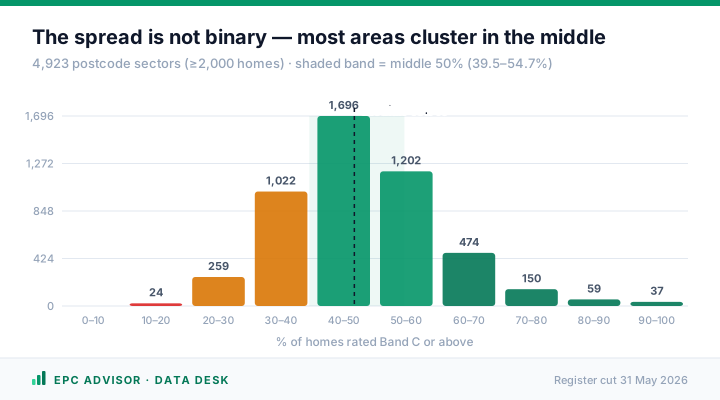
How the 4,923 qualifying sectors are spread. The shaded band marks the middle 50% (39.5–54.7%). Register cut 31 May 2026.
The district picture
Zoom out to postcode districts and the divide holds. Newly built districts sit at the top; the bottom is a mix of two very different places.
| Greenest districts | % C+ | Least-efficient districts | % C+ | |
|---|---|---|---|---|
| E20 — Stratford | 100% | SP3 — rural Wiltshire | 18.2% | |
| MK10 — Milton Keynes | 93.7% | TR19 — Land's End, Cornwall | 18.9% | |
| PE7 — Peterborough | 93.1% | B67 — Smethwick | 19.0% | |
| M50 — Salford Quays | 90.7% | LL53 — Llŷn, Gwynedd | 19.5% |
It is the same story one level up: among local authorities, Tower Hamlets leads at 78% Band C+. At the bottom, the Isles of Scilly — fewer than 850 homes, almost all off the gas grid — sits at just 11%, with Gwynedd the lowest of the larger authorities at 27%.
Download the full data. These league tables are the top and bottom of the full ranking, which is free to reuse under the Open Government Licence: EPC bands by postcode sector (CSV) — all 4,923 qualifying sectors — and EPC bands by postcode district (CSV) — all 1,848 qualifying districts. Each row gives the band A–G counts and the Band C+ rate. Every release, a searchable version of these tables and reusable charts are on our EPC statistics and open data page.
Two roads to a poor rating
The top of the table is simple to explain — modern building regulations. The bottom divides into two distinct groups, and they need different fixes:
- Older urban terraces. Inner Birmingham (B44, B11, B10), Smethwick, Halifax and Leicester are dense Victorian and inter-war housing. Solid brick walls and historic layouts mean the cheap wins are limited; solid-wall insulation and heating upgrades do the heavy lifting.
- Rural, off-gas-grid homes. Cornwall (TR19, PL30), the Llŷn Peninsula in Gwynedd and rural Wiltshire rely on oil, LPG or direct electric heating — the single biggest drag on an EPC score. For these homes, the rating story is mostly a heating story.
For anyone planning works, the order of operations matters more than the postcode — see our guides to the cheapest ways to improve an EPC and how to improve your rating.
The national backdrop — and why 2030 matters
The local extremes sit on top of a slow national improvement. Homes are getting greener at the point of certification: among newly lodged certificates, the share rated Band C+ has climbed from 38.9% in 2008 to 64.1% in 2026 (the 2026 figure covers certificates lodged 1 January to 31 May), and the worst-rated (F and G) share has fallen from 8.7% to 1.3%.
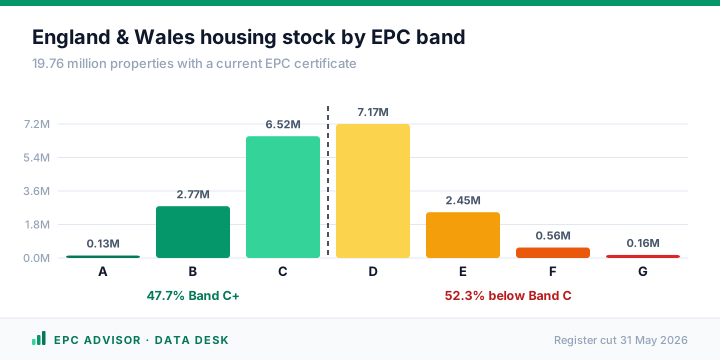
The full band profile of the 19.76 million properties with a current EPC. The bulk of the stock sits at Band D, just below the Band C line. Register cut 31 May 2026.
But the existing stock lags the new-build trend. With 52.3% of certified homes still below Band C, the gap to the government's intended 2030 Band C standard for rented properties is wide — and, as the league tables show, concentrated in specific places. (The 2030 standard is confirmed government policy intention under the Warm Homes Plan, not yet enacted law.) Landlords in the least-efficient districts face the steepest climb; our landlord EPC guide covers what's required, including the 2030 band C timeline and cost cap.
What this means for your property
A national or sector average can't tell you about your home — two houses on the same street can be bands apart depending on their walls, heating and glazing. The only way to know your starting point is your own certificate.
Look up your postcode to see your area's band distribution and the most common recommended improvements, then view your property's full EPC and personalised next steps. If no certificate exists — or yours is out of date — you'll need a new assessment from an accredited assessor.
Cite this analysis. "As of the 31 May 2026 EPC register, the gap between the greenest and least-efficient postcode sectors in England and Wales reached 88 percentage points in Band C+ rate (the greenest sectors, such as Battersea's SW11 7, at 100% vs Birmingham's B44 8 at 11.6%); 52.3% of all certified homes remain below Band C." — EPC Advisor Data Desk. Free to quote with attribution and a link to this page.
Methodology, data source and limitations
- Source: the official MHCLG "Get Energy Performance Data" service for England and Wales, published under the Open Government Licence v3.0. Register cut 31 May 2026; 29,162,710 certificates across 19,762,261 properties.
- Area figures count each property once, by its most recent certificate. To avoid unstable rankings from small samples, sector tables include only sectors with ≥2,000 homes (4,923 of 8,588) and district tables only districts with ≥3,000 homes (1,848 of 2,368).
- "Band C+" means a current energy rating of A, B or C. Percentages are rounded to one decimal place; sectors and districts shown as "100%" have at least 99.95% of homes at Band C or above. The longitudinal 2008–2026 trend counts certificates by lodgement year (a flow measure), distinct from the stock snapshot above; the 2026 data point is year-to-date (certificates lodged 1 January to 31 May 2026) and so covers a partial year.
- Download: the full sector and district league tables are published as CSV under the Open Government Licence — postcode sectors and postcode districts — free to reuse with attribution to EPC Advisor.
- Scope: England and Wales domestic EPCs only; Scotland and Northern Ireland use separate registers. Certificates lodged before 2012 may carry limited improvement data.
- Policy note: the EPC Band C target for rented homes by 2030 is confirmed government policy intention (Warm Homes Plan, January 2026), not enacted law; the proposed Home Energy Model methodology overhaul is expected from H2 2027.
- For cross-reference, see the ONS energy efficiency of housing release and the GOV.UK Energy Performance of Buildings statistics, both at local-authority level.