Gas standing charges are going. At the Budget on 28 October 2026, the government said it has asked Ofgem to abolish them on household bills, aiming for the end of 2027 or as soon as possible after then. The cost will move onto the price of each unit of gas instead.
That means some households save and some pay more. We used government meter data on how much gas homes really use to work out who is likely to gain, and how it varies with a home's EPC rating.
The short answer: homes that use less gas than average save. Homes that use more pay more. The typical home rated A to D comes out ahead. The typical home rated E or F pays a little more.
Last checked against the Budget 2026 document, the government's announcement, Ofgem's price cap and DESNZ's National Energy Efficiency Data-Framework on 28 October 2026.
Gas standing charges at a glance
| Key fact | Detail |
|---|---|
| What is changing | The daily gas standing charge is abolished and its cost moves onto the gas unit rate |
| When | The government is aiming for the end of 2027, or as soon as possible after then |
| Where | Household gas bills in England, Scotland and Wales |
| Today's charge | 29.68p a day, about £108 a year (Direct Debit average, October to December 2026) |
| Government estimate | 60% of households with a gas account could save around £45 a year on average |
| Who may pay more | Higher gas users. The government says it will set out targeted help |
| Electricity | Standing charges stay for now. Reform details are due in 2027 |
Step 1 of 3
Check your home's EPC
Enter your postcode to see this property's current rating, expiry date and the improvements its certificate recommends. Once the standing charge moves onto the unit rate, every unit of gas you save is worth more.
When will gas standing charges end?
The Chancellor announced the change in the Budget on 28 October 2026. The government has asked Ofgem, the energy regulator, to make it happen. It is aiming for the end of 2027 or as soon as possible after then.
Until then nothing changes, and standing charges stay on your bill. Ofgem will make sure suppliers recover the costs through gas unit rates instead, working with suppliers and consumer groups to keep the market stable and competitive.
How the change works
A standing charge is a fixed daily fee. You pay it even if you use no gas at all. Under the October to December 2026 price cap, the average gas standing charge for Direct Debit customers is 29.68p a day, or about £108 a year, including VAT. It varies by region and payment method.
When the standing charge goes, suppliers will recover the same costs through the unit rate, the price you pay for each kilowatt hour (kWh) of gas.
Our estimate of the new unit rate: in 2024, the average home with gas in England and Wales used about 11,200 kWh, according to DESNZ. Spreading £108 evenly over that much gas adds just under 1p per kWh. Under today's cap that would take the unit rate from 7.97p to about 8.9p. Ofgem has not set the real figure.
The break-even point is therefore average gas use. Use less than about 11,200 kWh a year and you are likely to save. Use more and you are likely to pay more.
Who saves and who pays more
Here is the estimated yearly change at different levels of gas use. It uses October to December 2026 prices and DESNZ's 2024 figures for how much gas homes use.
| Yearly gas use | Estimated change |
|---|---|
| 5,000 kWh | Save about £60 |
| 6,500 kWh (a quarter of homes use less than this) | Save about £45 |
| 10,000 kWh (the typical, or median, home) | Save about £12 |
| 11,200 kWh (the average home) | About the same |
| 14,400 kWh (a quarter of homes use more) | Pay about £31 more |
| 20,000 kWh | Pay about £85 more |
Most homes use less than the average, because a smaller number of very high users pull the average up. That is why the government estimates that 60% of households with a gas account could save around £45 a year on average. Interpolating between DESNZ's published quartiles, we estimate a similar share: roughly 57% of homes use less than the average.
Homes that use very little gas gain the most, such as homes with a heat pump that kept a gas hob. They would save close to the full £108.
By EPC rating: the typical home in each band
DESNZ links real gas meter readings to EPC records. That shows how much gas the typical home in each EPC band actually uses, and therefore who is likely to gain.
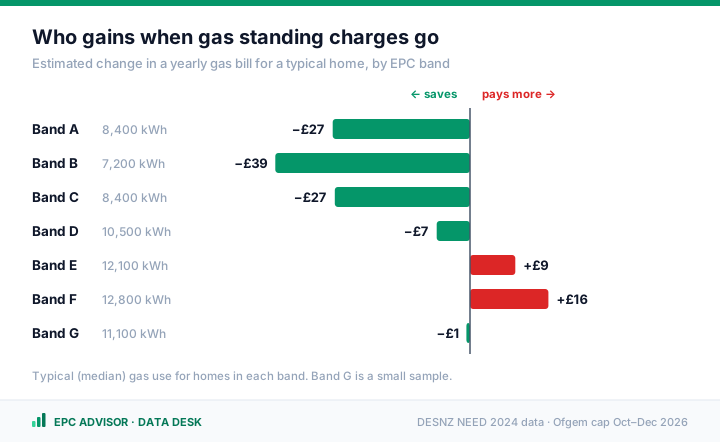
| EPC band | Typical yearly gas use | Estimated change |
|---|---|---|
| A | 8,400 kWh | Save about £27 |
| B | 7,200 kWh | Save about £39 |
| C | 8,400 kWh | Save about £27 |
| D | 10,500 kWh | Save about £7 |
| E | 12,100 kWh | Pay about £9 more |
| F | 12,800 kWh | Pay about £16 more |
| G | 11,100 kWh | About the same |
What this shows:
- More efficient homes gain. The typical home rated A, B or C uses well under average gas, so it saves.
- Less efficient homes pay a little more. The typical E- or F-rated home uses more gas than average, so moving the standing charge onto each unit costs it more.
- Band G is a small group. About 33,000 homes in the data, so treat its figure with care.
- Your own use matters more than your band. A large C-rated house can use more gas than a small E-rated flat. Size, the number of people at home, and how warm you keep it all matter.
The amounts are modest either way. But the change does shift a little of the cost of gas towards homes that need more heat, and an EPC gives a modelled estimate of exactly that.
Check whether you will gain
- Find your yearly gas use in kWh on your bill, your supplier's app or your annual statement.
- Compare it with 11,200 kWh, the average.
- For a rough figure, divide your use by 11,200, take away 1, and multiply by £108. For example, 8,000 kWh gives (8,000 ÷ 11,200 − 1) × £108, a saving of about £31 a year.
Prices will change before 2027, and Ofgem may not spread the cost exactly evenly. So treat the result as a guide to direction, not a forecast.
What it means for heat pumps
Moving the standing charge onto the unit rate makes each unit of gas dearer and leaves electricity prices unchanged. Under today's cap, electricity costs about 3.3 times as much per kWh as gas. With the standing charge moved onto gas units, that gap would narrow to about 2.9 times.
A smaller gap makes heat pumps cheaper to run compared with a gas boiler. Octopus Energy's founder made the same point when the change was announced.
If you are weighing up a switch, the Boiler Upgrade Scheme pays £7,500 towards a heat pump in England and Wales. The Warm Homes Loan Scheme can spread the rest of the cost. See our heat pump guide for whether one suits your home.
How to cut your gas use before the change
If you are a higher gas user, the cheapest savings usually come first:
- Check your EPC recommendations. They list the improvements most likely to cut your heating demand, roughly in order of cost.
- Insulate the loft and cavity walls if they are not already done. These are typically among the cheapest measures per unit of gas saved. See loft insulation and your EPC.
- Improve heating controls, such as a programmer, room thermostat and thermostatic radiator valves.
- Check grants first. ECO4 runs until 31 December 2026, and councils deliver the Warm Homes: Local Grant in England.
Insulation, heat pumps and heating controls currently carry 0% VAT. This rises to 5% on 1 April 2027.
Who might need help
The government accepts that "a number of households may be less able to make the most of the reform". These are households that use a lot of gas and cannot easily cut it. It has promised targeted mitigation and will set out details later.
Electricity standing charges
Electricity standing charges are not being abolished. The government has committed to reform them and will set out details in 2027. For other Budget changes to bills, including the £100 Household Energy Payment and 0% VAT on electricity until 30 June 2027, see our Budget 2026 guide.
How we estimated this
- Standing charge: Ofgem's October to December 2026 price cap, Direct Debit average of 29.68p a day including 5% VAT (£108.33 a year).
- Gas use: DESNZ National Energy Efficiency Data-Framework (NEED), consumption data tables 2026, covering 2024 in England and Wales. The average (mean) for all 18.9 million homes with gas is 11,191 kWh. Typical use by EPC band is the median in Table 27c, for homes with an EPC.
- Model: we assume the standing charge is recovered evenly across all gas used, so each home's yearly change is its use divided by average use, minus 1, times £108.33. It does not allow for people changing how much gas they use, regional differences, future price changes, or the targeted help the government plans.
- Rounding: gas use is rounded to the nearest 100 kWh and the results to the nearest pound.
The chart is free to reuse with a credit and link to this page.
Sources
- HM Treasury: Budget 2026 document (28 October 2026)
- Prime Minister's Office, HM Treasury and DESNZ: Chancellor abolishes standing charges on gas bills to make payments fairer (28 October 2026)
- Ofgem: Energy price cap unit rates and standing charges (October to December 2026)
- DESNZ: National Energy Efficiency Data-Framework (NEED): consumption data tables 2026 (June 2026)
- DESNZ: NEED report: summary of analysis 2026 (June 2026)